
Flat Panel Detectors in Modern Radiography: What DQE, a-Si vs CMOS, and CsI vs GOS Actually Mean for Your Department
Flat Panel Detectors (FPDs) have quietly replaced CR cassettes and film in most markets — but not all FPDs are built the same. If you’re specifying a detector for a new DR room, retrofitting a legacy system, or sourcing for a distributor network, the alphabet soup (a-Si, a-Se, CMOS, CsI, GOS, DQE, MTF) actually maps to very concrete decisions about dose, image quality, and total cost of ownership.
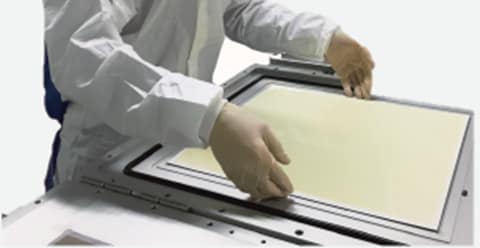
Three Sensor Technologies, Three Use Cases
- Amorphous Silicon (a-Si) — the workhorse. Mature, cost-effective, excellent for general radiography and retrofit kits. Most 14×17″ and 17×17″ panels destined for ER, orthopedics, and veterinary clinics are a-Si based.
- Amorphous Selenium (a-Se) — direct conversion. No scintillator layer, so theoretically higher spatial resolution for mammography and fine-bone work, but more sensitive to environmental factors and historically pricier.
- CMOS — the speed king. Smaller active areas (common in C-arm / fluoroscopy), extremely low readout noise, high frame rates. If your workflow is live guidance rather than static chest X-rays, CMOS enters the conversation.
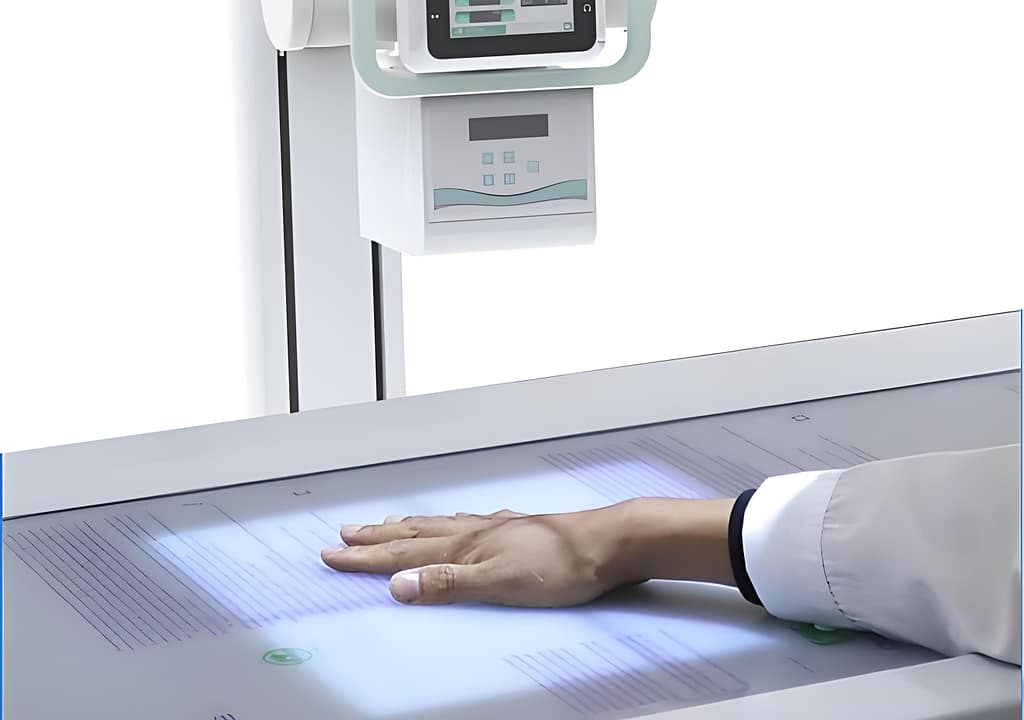
Scintillator Choice: CsI vs GOS
This is where marketing brochures blur the truth. Both cesium iodide (CsI) and gadolinium oxysulfide (GOS) are legitimate; they trade off differently:
- CsI (needle-structured): Higher DQE at diagnostic energies, better low-dose performance, sharper soft-tissue gradient. Preferred for thoracic, pediatric, and any department chasing ALARA.
- GOS (powder): Mechanically tougher, cheaper to produce, perfectly adequate for orthopedic, chiropractic, and veterinary where dose isn’t as constrained and budget drives the spec.
The Two Numbers That Actually Matter: DQE and MTF
Forget “pixel pitch = sharpness” as a sole metric. Two specs tell the real story:
- DQE (Detective Quantum Efficiency) — how efficiently the detector uses incoming X-ray photons. Higher DQE = same image at lower dose, or cleaner image at same dose. Look for DQE @ 0 lp/mm in the 60–70% range for decent a-Si CsI panels.
- MTF (Modulation Transfer Function) — how well spatial detail survives the capture chain. 3.5 lp/mm is a common benchmark for 140 μm pixel panels; 100 μm pushes toward 5 lp/mm for small-animal vet or extremity work.
Where 233 Medical Fits
We manufacture and export a-Si FPDs in both CsI and GOS configurations, 10×12″, 14×17″, 17×17″, wired and wireless, carbon-fiber housing, ≤3 s image acquisition, PACS/RIS-ready. All units ship with CE and ISO 13485 documentation, and we support OEM/white-label for regional distributors. Retrofit kits (cable + software bridge) are available for common legacy DR hosts — the most cost-effective path when the room exists but the detector doesn’t.
233 Medical — Export-grade flat panel detectors, CE/ISO certified, distributed in 80+ countries.